




No Fixed Abode NGO - Vailla Vakinaista Asuntoa Ry
No Fixed Abode, Vva ry, is an NGO whose purpose is to reduce homelessness and improve services for homeless people. We work together with our visitors to find suitable housing solutions for each one, as well as with other actors to influence Finnish housing policies. We act as the only advocates of the interests of homeless people in the third sector. Vva is not committed to any political parties’ or religious communities’ agenda, and all our operations are non-profit.
Our main premise is that every person can live independently if they are provided with adequate conditions and support. Housing is a fundamental human and social right, and its absence cannot be accepted under any circumstances.
The purpose of all activities of Vva is to ensure that everyone will find a decent place to live within an acceptable time.
We are a nationwide organization. Our office is located in Helsinki and our services are concentrated in the Helsinki metropolitan area, where the majority of Finland’s homeless people reside.
Our work is divided into a low-threshold services, housing services and NGO work.
Vva was founded in 1986 by homeless people themselves, when there were 20 000 homeless people in Finland. Now the number is 4 579.
Vva also started the first piloting project for housing first model in Finland, in 2007.
Today Vva has about 40 employees working in various areas of service. About 40 percent of our employees have first-hand experience of homelessness.
-
The thought behind creating Vva in 1986 was to get rid of the shelters and make sure that the basic right of housing would be realized for everyone.
In 2008 Finland became the first European country to embrace the Housing First -model, which aims to provide rough sleepers a home as quickly as possible, complete with a personal lease contract that’s permanent and stable. The policy works by phasing out homelessness shelters.
Permanent housing enables people to live and function independently.
People can choose how to be involved with services. Giving up intoxicants completely is not required – instead, the approach is one of harm reduction, in a way that respects the person’s autonomy.
Staff members meet the inhabitants as equals, to build trust and empower them.
Staff supports each person’s integration into the community and helps them build strong networks.
Vva still runs housing unit SÄLLIKOTI, with 28 apartments, which was the first piloting project for housing first model in Finland.
-
Our low-threshold services are aimed at everyone who is homeless or threatened with homelessness. Vepa's activities are open to everyone.
Most of our services are located in Itä-Pasila, Helsinki. The housing counselor is on call at our organization's office on working days and once a week in Vantaa.
Outreach team with a van
An outreach team Yökiitäjä moves around the metropolitan area. We give advice on homelessness on the phone for people all around Finland.You can inform the Yökiitäjä staff on duty at night, if you are worried about someone sleeping rough, or if you notice someone whom you believe to be homeless.
Accessibility
Our office's / Vepa's / Kalkkers' entrance has steps. Please contact us and we’ll assist you. -
Everyone is accepted into Vepa just the way they are. In Vepa, you can rest, spend time, eat a warm meal, tell about your problems and receive support for the suitable service. Vepa serves a warm meal, coffee, tea and bread. You can wash and dry your clothes. There are a computer and a phone that you can use for running errands.
At Vepa you can contact and reserve an appointment with our housing counselor, to get in contact with a floating support worker and an immigrant specialist. In Vepa, donated clothes are handed out. Peer employees work in Vepa.
Open hours: Mondays to Fridays from 9 AM to 7 PM, except on Thursdays from 9 AM to 2 PM and again from 5 PM to 7 PM.
Vepa is closed in July.Address: Ratamestarinkatu 6, 00520 Helsinki
Tel. 050 443 1065
vepa@vvary.fi -
Night centre Kalkkers is a low threshold crisis spot for the homeless. In Kalkkers you can rest safely, get first aid and some snacks, food, tea and coffee. You can talk about your situation and get help to find suitable services. Kalkkers is open for half a year during the winter time. In Kalkkers donated clothes are handed out. There is also a computer and phone you can use.
Kalkkers does not provide shelter. It offers a warm place to spend the night is for fifteen people regardless of their place of domicile, nationality or the status of the residence permit. You can get inside also while intoxicated, but the use of substances is prohibited there.
Open times: Monday-Sunday 22-06 (winter season).
Kalkkers will be open for its final night of this spring season on the night between April 29th and 30th. The night center will reopen for the winter season in October–November.
Address: Ratamestarinkatu 6 (Itä-Pasila), 00520 Helsinki
Tel. 050 433 1068
kalkkers@vvary.fi
Emergency accommodation services provided by other organizations for people experiencing homelessness :🔹 Hietaniemenkatu Service Centre (Helsinki)
(Access to the City of Helsinki’s Lauttasaari emergency accommodation unit is also arranged through Hietaniemenkatu Service Centre)
Hietaniemenkatu 5 B
📞 09 3104 6628🔹 The City of Helsinki’s Pitäjänmäki emergency accommodation unit for undocumented people:
Applications are primarily made on weekdays between 9:00–16:00 via the Kalasatama Health and Wellbeing Centre (Työpajankatu 14 A). In the evenings after 20:00 and on weekends, clients can go directly to Kornetintie 10.🔹 Nuoli (for ages 16–29, 24/7)
Mäkelänkatu 50, Helsinki
📞 044 354 1119Emergency accommodation in Vantaa and Espoo:
🔹 Koisoranta Service Centre (Vantaa)
Koisotie 5
📞 040 762 443🔹 Olarinluoma (Espoo)
Luomanportti 9
📞 050 051 5978 -
Immigration services are targeted at homeless immigrants, especially when your rights to social security and services are unclear. Our immigration expert helps individually to find out the situation and solutions and guide you to appropriate services. In addition to housing issues, you can learn about your rights to social security and services.
Guidance for migrants:
Heini Puurunen
Tel. +358 44 260 3818
heini.puurunen@vvary.fi
Receptions on Mondays and Tuesdays (not on October 7th, 13th, 14th), on other days of the week by prior arrangement.Service in: Finnish, English and Bulgarian.
-
Read more about our low threshold services in Finnish.
-
Erja Morottaja
tel. +358 44 773 4700
erja.morottaja@vvary.fi
Information on Homelessness in Finland
Homelessness is a situation and a condition, not a personal characteristic. It is a societal problem, with underlying causes including inequality, economic fluctuations, population growth, and urbanization.
Here are some writings by VVA ry related to homelessness:
-
The number of homeless people in Finland has increased sharply, according to Varke’s Homelessness Survey 2025. In November 2025, there were 4,579 single-person homeless individuals, a 20% increase from the previous year. Homelessness has now risen for the second consecutive year, after more than a decade of steady decline.
The increase in homelessness is driven by cuts to social security and housing support, rising living and housing costs, unemployment, and difficulties paying rent.
“Right now, as homelessness is increasing sharply, government decisions seem to be pushing even people with housing into financial distress. Kela requires many low-income individuals to move out of apartments deemed too expensive, even when the difference is only a few tens of euros. Some of these people end up homeless,” notes Jussi Lehtonen, Service Manager at Vailla vakinaista asuntoa ry (VVA).
Lehtonen highlights Turku as an example, where about 25% of social assistance recipients live in apartments considered too expensive by Kela, and they are required to move to cheaper housing. However, affordable housing is in short supply. At the same time, the planned reduction in state-supported rental housing from 2027 onward threatens to worsen the situation further.
Homelessness increased in nearly all major cities. Helsinki had the most homeless people, nearly 980, about one-fifth of all homeless in Finland. Significant increases were also seen in Vantaa and Tampere. Long-term homelessness remains concentrated in large cities, and in Helsinki, the number of long-term homeless rose for the first time since 2020.
The growth is especially evident among young people, women, and long-term homeless individuals. In 2025:
Young homeless people under 25: 761, nearly 40% increase from the previous year
Homeless women: 1,023, a 24% increase
Long-term homeless individuals: 1,306, a 28% increase
Homeless people with an immigrant background: 966, 22% higher than in 2024, representing about one-fifth of single-person homeless
Homeless men: 3,556, a 19% increase from the previous year
The majority of homeless people temporarily stay with friends or relatives. In 2025, there were 2,945, over 500 more than in 2024.
“Hidden homelessness often remains invisible in statistics because people are outside the reach of services or their housing insecurity is not recorded in registries,” Lehtonen points out.
“Some avoid services because they do not feel safe or suitable for their situation.”Long-term homelessness numbered 1,306, a 28% increase compared to 2024. Street homelessness has also risen: 758 people slept outdoors, in stairwells, or in emergency shelters, with the relative increase highest among long-term homeless individuals.
According to VVA’s observations, an increasing number of people are sleeping in public or semi-public spaces, cars, and temporary shelters, and both physical and mental health are clearly deteriorating.
“In Helsinki, emergency accommodation spaces have been increased, even providing room during freezing nights. Still, a worrying number of people remain outside these services. We urgently need to understand why people are not using them or are no longer able to accept help,” Lehtonen notes.
Hunger also affects a growing number of people encountered by VVA services, including some with housing.
Cutbacks to preventive services, such as housing guidance, threaten to exacerbate the situation. Housing guidance has proven effective in preventing evictions and homelessness, but cuts jeopardize access to these services and the government’s own goal of eliminating homelessness.
Homelessness is not an individual failure but a result of political choices. It is humanly distressing and socially costly. Homelessness can still be eradicated in Finland, but this requires long-term, responsible housing and social policies, strengthened preventive services, and support for the operations of civil society organizations. Housing is a fundamental right and a prerequisite for a life with dignity.scription
-
This year, Vailla vakinaista asuntoa ry (VVA) celebrates its 40th anniversary. The organisation was founded on the initiative of people experiencing homelessness themselves at the Lauttasaari shelter. Their goal was simple and concrete: to move away from communal accommodation and towards a permanent home of one’s own.
Much has changed since those days. Yet in public debate, civil society organisations are increasingly portrayed as a cost rather than an asset, even though for many people they represent the last—and sometimes only—safety net. They fill gaps in the service system and reach people who might otherwise be left entirely without support.
People currently experiencing homelessness and those with lived experience of homelessness remain at the heart of VVA’s work, both as employees and volunteers. Our guiding principle has remained unchanged for four decades: everyone has the right to a home, regardless of their background or life situation. Yet today, that right is not being realised. An increasing number of people are sleeping in public and semi-public spaces, cars, and temporary shelters.
The Statistics Point to a Change in Direction
Varke’s Homelessness Survey 2025 confirms a deeply concerning trend. There are currently 4,579 single homeless individuals in Finland, 20 per cent more than a year earlier. Long-term homelessness has increased by 28 per cent. A total of 758 people are sleeping outdoors or in emergency shelters. Youth homelessness has risen by nearly 40 per cent. There are 1,023 homeless women, representing a 24 per cent increase from the previous year. Hidden homelessness is also growing, with more people forced to rely on relatives and friends for temporary accommodation.
For more than a decade, homelessness in Finland declined thanks to determined and coordinated efforts. This work transcended political divisions and was based on research, evidence, and practical solutions that were proven to work. The Housing First model, strengthened housing advice services, and close cooperation between municipalities and civil society organisations delivered tangible results. However, in 2023 the trend began to reverse.
Homelessness Does Not Happen by Accident
Forty years of working alongside people experiencing homelessness has taught us one important lesson: homelessness does not increase by chance. It increases as a consequence of policy decisions.
Cuts to social security and housing benefits, along with their increasingly strict implementation, are a central part of the problem. Kela requires low-income tenants to move out of apartments considered “too expensive,” sometimes because of rent differences amounting to only a few dozen euros. When affordable housing is unavailable, pressure to move significantly increases the risk of homelessness. What may appear as a small saving for the state can mean the loss of a home for an individual.
At the same time, funding for housing counselling has been reduced, and state-supported rental housing production is being scaled back. The burden of a structural shortage of affordable housing is being shifted onto those with the fewest resources. These decisions do not merely fail to prevent homelessness—they actively push more people into it.
The implementation of housing benefits must not contribute to homelessness. Greater flexibility and discretion are needed. Minor rent differences should be treated more reasonably, and people should not be required to relocate when no realistic housing alternatives exist.
The Consequences Are Visible in Everyday Life
The growing cost-of-living crisis is also evident at VVA’s low-threshold meeting places and support services. Increasing numbers of people—including those who still have housing—are forced to cut back on food and medication simply to keep a roof over their heads.
At VEPA, VVA’s peer support and volunteer centre, visitors use the service phone to contact electricity providers because they can no longer afford to pay their utility bills.
Homelessness is not a personal moral failure, nor is it solely a question of substance use or mental health issues. It increasingly affects low-income workers, students, families with children, and older people. Many individuals experiencing homelessness—or living under the threat of it—also do not fit neatly into rigid health and social care structures. People do not seek help if services feel unsafe or unsuitable for their circumstances.
Women on the Margins of Homelessness
Women experiencing homelessness often remain invisible.
Services that are perceived as unsafe can leave women trapped in hidden homelessness, staying temporarily with acquaintances, remaining in abusive relationships, or becoming dependent on others for accommodation.
Homelessness services have historically been designed largely around the needs of men. There are too few women-specific and gender-sensitive services. Safe emergency accommodation, low-threshold spaces, and accessible shelter services are urgently needed—including for women who use substances.
We need places where everyone can feel safe and rest without fear.
We Know What Works
Housing is, fundamentally, a human right. Without a home, there can be no dignified life and no genuine participation in society. Finland has already demonstrated that homelessness can be reduced through determined and consistent action.
Homelessness can still be ended if:
Social security and housing benefits are not further weakened;
Kela’s implementation practices are reformed so that they do not increase the risk of homelessness;
Housing advice services and preventive support are strengthened;
Affordable rental housing construction is increased;
The operating conditions of civil society organisations are safeguarded; and
The needs of women and other vulnerable groups are better recognised.
The Housing First model is an internationally recognised solution that has proven effective in Finland. Its core principle is simple: permanent housing is the starting point, not a reward.
This principle enjoyed broad political commitment in Finland across successive governments. Reducing homelessness was not viewed as an ideological issue but as a shared national goal.
That consensus can be rebuilt.
Homelessness is the result of political choices, and for that reason it can also be ended through political choices. We know how to do it.
What is needed now is the will to act.Item description
-
When we talk about safety in urban spaces, we often focus on what the city looks like, how it feels, and the kinds of situations we encounter in everyday life. We talk about disturbances, substance use, and disorder. That is understandable. People’s concerns about their own safety are real.
But let us shift the perspective for a moment.
If we want to truly understand safety, we must also ask another question: safe for whom, and unsafe for whom?
From the perspective of people experiencing homelessness, safety looks very different. Without a home, a person’s life takes place almost entirely in public space. Everything happens there: sleeping, eating, resting, socialising, falling in love, coping with crises. Yet public space is not designed for living. As a result, people are constantly exposed to disturbances, conflict, and violence.
This reality is evident in the daily work of Vailla vakinaista asuntoa ry (VVA). People experiencing homelessness repeatedly tell us about experiences of physical, psychological, and sexual violence. Often, the perpetrator is not another homeless person, but a complete stranger, a passer-by, or sometimes even a representative of security or law enforcement.
“People experiencing homelessness are often seen as a source of insecurity. In reality, homelessness itself is a source of insecurity for the person experiencing it. Once we understand this, the entire conversation about safety changes.”
A good example of this can be found in the Kallio and Sörnäinen districts of Helsinki. For nearly two decades, VVA operated low-threshold day and night centres in the area: VEPA and Kalkkers. These were places where people could rest, eat, access support, spend time indoors, and be seen and heard. In short, places where they could simply be human among other people.
When these services were forced to relocate elsewhere, some may have assumed that the associated problems would disappear as well.
They did not.
The people did not disappear. They remained in the area, but without a place to go. The result was immediately visible in the form of increased disorder and tension in public spaces.
This illustrates a crucial point about safety: removing services does not remove the phenomenon. It merely makes it more visible and harder to manage. Safety is not created by pushing people out of sight. It is created by ensuring that people have somewhere to be.
Another important perspective concerns who is at risk of homelessness today.
As a consequence of austerity measures and cuts to social protection, homelessness has increased for the second consecutive year in Finland. Homelessness is not simply a substance use or mental health issue. Increasingly, it affects low-income workers, students, families with children, and pensioners.
The causes may include unemployment, rent arrears, interruptions in social benefits, relationship breakdown, illness, or other difficult life circumstances that can quickly escalate.
Homelessness is often a predictable chain of events rather than a sudden collapse.
And this brings us back to safety in a broader sense.
One of the most persistent misconceptions is that cutting services and reducing support for civil society organisations saves public money. In the case of homelessness, this is simply not true.
The costs do not disappear. They are transferred elsewhere: to the police, emergency healthcare, emergency accommodation, and social emergency services. At the same time, the situations that contribute to feelings of insecurity among other city residents become more common.
Safety is therefore not a separate issue from homelessness. The two are directly connected. In fact, housing is one of the most fundamental structures of public safety.
There is also another dimension that is often overlooked in public discussions: public space itself.
Cities are constantly engaged in a quiet negotiation over who has the right to be where. Who is tolerated? Who is moved along? Who is asked to leave?
For people experiencing homelessness, this negotiation is highly visible. They are removed from spaces, monitored, and restricted in where they can stay. Sometimes this is because of their behaviour. Sometimes it is simply because of their appearance.
This creates a constant sense of uncertainty.
Where am I allowed to be?
For how long?
What happens next?
Safety is not only about physical security. It is also about predictability and the right to exist without being continuously pushed away.
At the same time, it is important to acknowledge that people’s concerns about safety are real. Disorder, substance use, and visible crises can be unsettling and frightening. These concerns should not be dismissed.
However, if we want solutions, we must focus on the causes rather than merely the consequences.
If a person spends their days on the street with nowhere else to go, it is hardly surprising that the effects become visible in the surrounding environment.
If that same person has housing and access to support and services, many of those situations disappear. This is not a matter of opinion; it is an observable reality.
That is why low-threshold services, day centres, and night shelters are not merely social services. They are also public safety measures. They reduce pressure on public spaces, prevent crises, and provide alternatives to spending time on the street.
And perhaps most importantly:
Safety is not created through fear or exclusion. It is created through inclusion.
There is no “us” and “them.” There is only us.
When people are pushed outside services, made invisible, and left without support, insecurity increases for everyone. When people are offered a place to stay, support, and a pathway forward, safety increases for all of us.
The question is not only one of compassion—whether we want to help people facing vulnerable and difficult circumstances.
It is also a question of what kind of city we want.
Do we want a city that functions well, and a city that is safe for everyone?
-
Finland succeeded in reducing homelessness through determined, long-term efforts beginning in 2008. The progress was exceptional even by international standards: while homelessness was increasing in many countries, Finland experienced the opposite trend for many years.
Since 2023, however, this positive development has taken a worrying turn. Homelessness has started to rise again. The reasons include increasing housing and living costs, as well as changes to social security benefits and housing allowances. This serves as a reminder that no achievement is permanent. Reducing homelessness requires continuous commitment, even after positive results have been achieved.
Finland's implementation of the Housing First model has attracted interest from around the world. The first question is often: how did Finland succeed in reducing homelessness when so many other countries have struggled?
There is no simple answer, nor did Finland discover a magical solution. The strength of the Finnish approach lies in the fact that Housing First has been implemented consistently as part of a broader housing and social policy framework. Housing First is not a single service or intervention but an approach to designing the entire system.
The basic idea of Housing First is straightforward. Permanent housing is not a reward that people earn only after committing to sobriety or meeting other conditions. On the contrary, stable housing provides the foundation from which other challenges in life can begin to be addressed.
This does not mean, however, that housing alone is enough for everyone. Many people also need flexible, long-term support with mental health, addictions, physical health, financial issues, or managing everyday life. It is precisely the combination of housing and needs-based support that distinguishes Housing First from housing policy alone.
At the same time, it is important to recognize the limits of the model. Housing First does not solve every form of homelessness.
When homelessness is driven primarily by low incomes and the high cost of housing, solutions must also be found in housing policy. An adequate supply of affordable housing, together with a well-functioning system of social security and housing support, is just as important as individualized support services. And without housing, Housing First itself cannot function.
This is precisely where Finland's success has differed from that of many other countries. The achievement was not simply the result of adopting a new service model. Finland also invested in affordable housing, converted shelters for people experiencing homelessness into ordinary rental housing designed to meet their needs, and strengthened cooperation between the national government, municipalities, non-governmental organizations, housing providers, and the service system. None of these measures would have been sufficient on its own. The results emerged from the combination of all these elements.
Another key reason for Finland's success has been its long-term commitment. Reducing homelessness has remained a national objective across successive governments, regardless of whether they were led by parties on the right, the centre, or the left. The model has not been redesigned after every election cycle; instead, it has evolved gradually on the basis of practical experience.
This may be the most important lesson for the future.
We live in a time when public debate increasingly emphasizes polarization, quick fixes, highly visible initiatives, and short-term results. Yet reducing homelessness does not follow the timetable of electoral cycles. Its effects become visible only gradually—in people's lives, in the service system, and in public finances. This requires the political courage to make decisions whose true significance may not become apparent until years later.
At the same time, we must recognize that no model is ever complete. Housing First itself should continue to be critically evaluated and refined in light of practical experience. Indeed, the ability to learn and make adjustments should be regarded as one of the defining strengths of the Finnish model.
This also helps explain why Housing First has not produced the same results everywhere. Housing markets, political institutions, and social challenges differ from country to country, and no single model can simply be transplanted from one context to another. In many countries, the core principle of Housing First has been adopted, but one or more essential components of the broader system have been missing. There may be too little affordable housing, funding may be insecure, or adequate support services may be unavailable. When any of these fundamental conditions is absent, more modest outcomes are almost inevitable.
Housing First is therefore not a ready-made concept that can simply be copied from one country to another. Rather, it demonstrates that homelessness can be reduced substantially when housing policy, health and social policy reinforce one another, when different actors work towards a common goal, and when there is a sustained commitment over time.
Ultimately, this is about human dignity. When people have a permanent home and, where necessary, the support they need, they have far greater opportunities to recover, participate in society, find employment, and rebuild their lives.
At the same time, it is also about the kind of society we want to build. Safety and social cohesion are strengthened when people are included rather than excluded. There is no "us" and "them"—there is only us. When people are pushed to the margins, left without support, and made invisible, insecurity grows for everyone. When they are offered a home, the support they need, and a genuine opportunity to move forward, the benefits extend far beyond the individual. Communities become stronger, cities become safer, and society as a whole becomes more resilient.
There is also a compelling economic case. Preventing and reducing homelessness requires investment, but allowing homelessness to persist is often far more expensive. When people are left without stable housing, they are more likely to rely on emergency healthcare, crisis services, temporary accommodation, and the criminal justice system — all of which are costly and often fail to address the underlying causes of homelessness. By contrast, stable housing combined with appropriate support can reduce the need for these emergency responses while enabling more people to work, study, and contribute to society. Over time, this not only improves individual lives but also reduces public expenditure.
The question, therefore, is not only whether we are willing to help people facing the most vulnerable circumstances. It is also whether we want to build cities and societies that are safe, inclusive, financially sustainable, and work well for everyone.
Written by Erja Morottaja
The writer is Communications Manager at VVA ry. She was recently interviewed on the Irish breakfast television programme Ireland AM to discuss Finland's Housing First approach to reducing homelessness.
Finland and Ireland have populations of a similar size. The interview was conducted at a time when homelessness in Ireland had reached a record high: more than 17,500 people were experiencing homelessness, including over 5,500 children. The main drivers of the crisis are the shortage of affordable housing, high rents, and an insufficient supply of social housing.
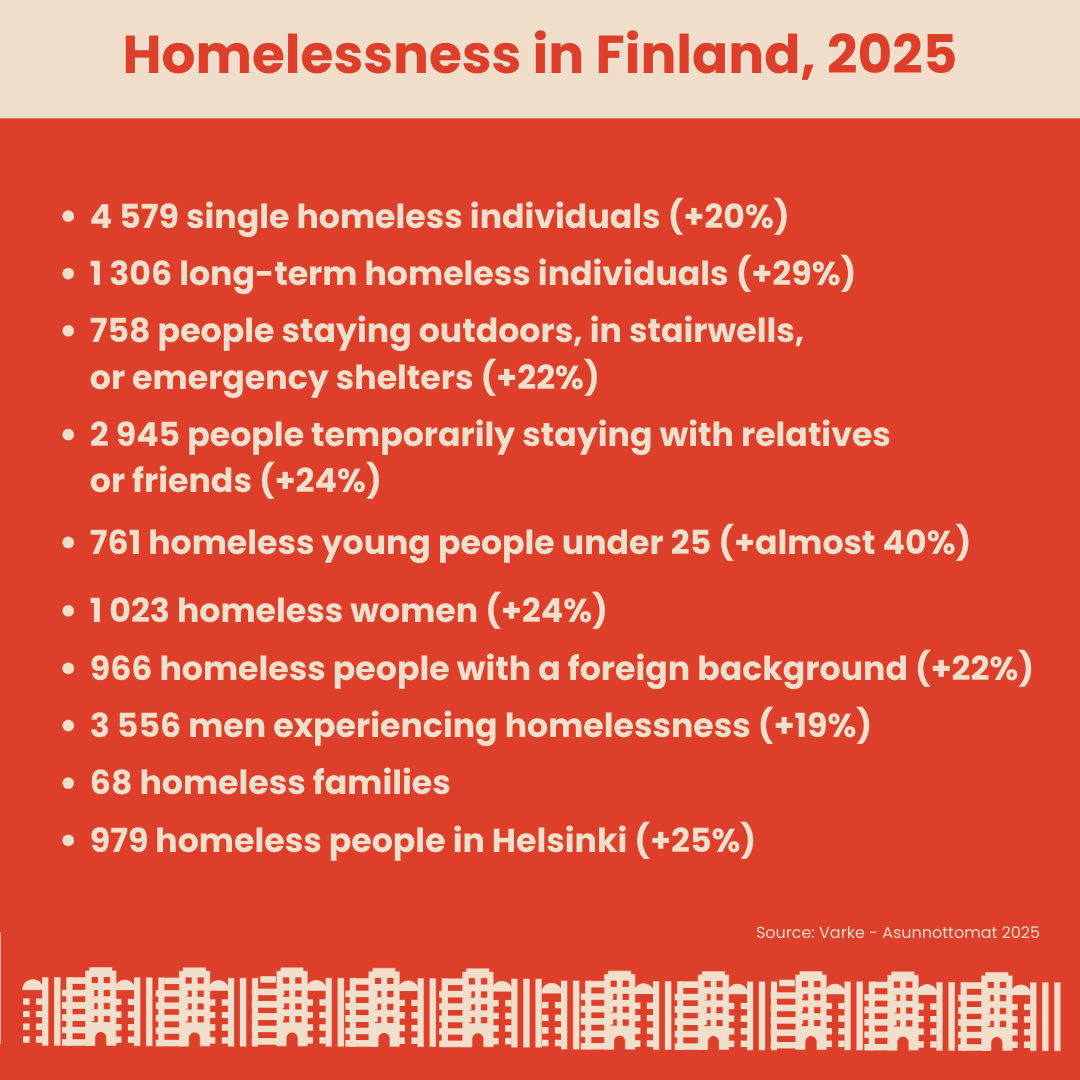
In the end of 2025, there were 4,579 single-person homeless people in Finland. The number of people experiencing homelessness has increased for the second consecutive year, following more than a decade of decline. Street homelessness has risen particularly sharply in the largest cities. A total of 758 people slept outdoors, in stairwells, or in emergency shelters, with the relative increase being highest among long-term homeless individuals.
These figures are based on the Varke Homelessness Survey 2025.
Homelessness is a situation and a condition, not a personal characteristic. It is a societal problem, with underlying causes including inequality, economic fluctuations, population growth, and urbanization.
According to the Finnish Constitution, everyone who cannot secure the basic conditions for a life of human dignity has the right to essential subsistence and care. In addition, the state has a duty to promote everyone’s right to housing.
The right to protection and security is a fundamental human right, and its absence cannot be accepted under any circumstances.